Soil carbon sequestration is the transfer and storage of atmospheric carbon dioxide in soil. How much farm soils can hold depends on plant inputs, management, climate and whether the practices continue.
It is one thread of sustainable farming practices, and this guide covers the mechanisms, the methods and the limits.
The route carbon takes into farm soil
Sequestration here means the transfer and storage of atmospheric carbon dioxide in pools such as soil or plant biomass, as defined in the Frontiers review. The review frames enhancing soil organic matter in agricultural soils as having potential to contribute to climate mitigation while also promoting soil health and resilience.
A review in Frontiers in Environmental Science describes the process as a carbon flow: plant material enters the soil, soil microbes process it, and part of the processed material attaches to mineral surfaces. The review says that increasing plant inputs to soils, whether from living plants or their organic residues, increases the resources available to soil microbes and promotes this flow.
The same authors name two key principles for building persistent soil organic matter: maintain carbon inputs to agricultural soils, particularly high-quality substrates that support efficient microbial metabolism, and reduce soil disturbances that disrupt biological and physicochemical interactions.
Soils are not only stores. A study in Scientific Reports notes that soils can act as both sources and sinks of carbon, depending on management, biomass input levels, micro-climatic conditions and bioclimatic change.
Farm practices linked to higher soil carbon
The Scientific Reports study states that research has shown land management practices can increase soil carbon stocks on agricultural lands, with practices including addition of organic manures, cover cropping, mulching, conservation tillage, fertility management, agroforestry and rotational grazing.
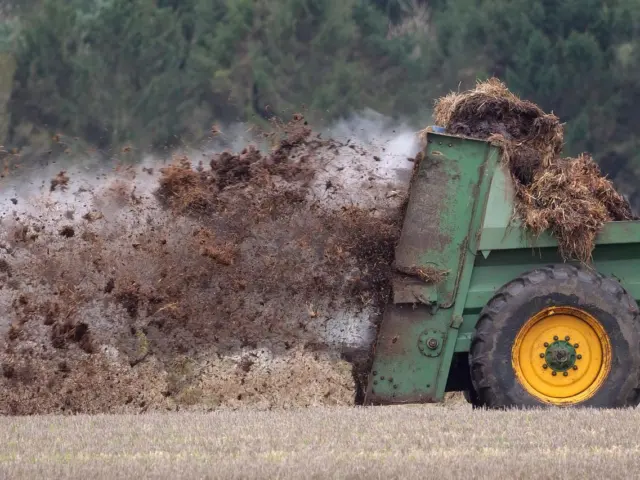
The Frontiers review singles out partially decomposed organic amendments such as compost and manure as especially good carbon sources, because organic molecules with simple structures and relatively low carbon-to-nitrogen ratios are more efficiently assimilated into microbial biomass and sorbed to mineral surfaces. It also lists tillage among the physical disturbances that can disrupt the bonds between organic matter and mineral particles.
The review also cites experiments in California showing that compost and winter cover crop additions result in significantly greater soil carbon stock gains than winter cover crops alone. It adds that maintaining nutrient availability, either through the carbon inputs themselves or with supplementary fertilizer additions, may also be necessary to support efficient microbial metabolism.
On tillage, the same review says that soil disturbances that repeatedly disrupt soil aggregates, such as frequent tillage, are likely to suppress carbon flows and result in carbon loss. It then says evidence suggests that infrequent or less destructive tillage practices do not cause the same disruption and do not result in significant carbon loss. The review also concludes that a single tillage event is unlikely to cause the massive loss of soil carbon that is commonly assumed in economic models.

The same review says that sequestration practices centred on biochar application are not likely to result in emissions reversals if the practice is ended. Its summary table adds that the additionality of carbon sequestered with biochar depends on the life cycle emissions of the biochar. Production, application and field results are covered in the guide to biochar in agriculture.
Rules for compost and manure on certified organic land are a separate matter, set out in the guide to USDA organic certification.
Estimated storage potential
For scale, the Scientific Reports study reports that the global soil carbon pool to one-meter depth is estimated at 2500 Pg C, about 3.2 times the size of the atmospheric pool. It states that substantially more carbon is stored in the world’s soils than is present in the atmosphere.
The Scientific Reports study estimates that croplands worldwide could sequester between 0.90 and 1.85 Pg C/yr, which it expresses as 26–53% of the target of the 4p1000 Initiative. It frames this as technical potential, and its estimates do not account for differences in climate or for important soil process issues, notably nutrient and water limitations and biomass production and turnover rates.
The same paper adds that, despite the large technical potential, there are often significant limitations to achieving it in any particular place and within specific farming systems, including lack of biomass and other inputs. It also notes that there may be tradeoffs with productivity, food security or hydrologic balances.
Its starting assumption is that in general, 50 to 70% of soil carbon stocks have been lost in cultivated soils, such that the organic carbon status of almost all cultivated soils can be increased.
Saturation and the slowing of gains
Soils do not keep accumulating carbon indefinitely. According to the Scientific Reports study, cropped soils are expected to sequester carbon for at least 20 years before reaching saturation points and new equilibriums, and a meta-analysis of field studies suggests that in some instances significant sequestration can continue for 30 or even up to 40 years.
The Frontiers review lists further constraints: supplies of nitrogen and phosphorus may constrain plant productivity and therefore pose limits to soil carbon accumulation, and additional issues include insufficient availability of organic biomass to add to soils and potential saturation of soil carbon storage.
Permanence, reversal and carbon credits
In carbon markets, the Frontiers review explains, permanence is a necessary condition for creditable emissions offsets. Sequestered carbon must remain sequestered during the period of the offset credits, which are typically issued for a 100-year period, although in newer markets temporary credits can be issued for periods as short as 25 years. In practice, permanence typically refers to how long a carbon-sequestering practice is carried out rather than to the soil carbon itself.
The authors state that the fact that carbon sinks in soil are not strictly permanent, meaning there is potential risk of reversal, is not unusual among carbon sequestration solutions. They add that even if ending a practice meant all the newly gained carbon would be lost, decay kinetics predict that it would take several years at a minimum.
The review adds that permanence concerns remain difficult to address directly with scientific data because of differences in terminology, definitions and focus between scientists and policymakers. It notes that the risk of reversal in forest biomass projects has been successfully managed through insurance-like schemes called buffers, suggesting that permanence is an important but manageable issue, and that a similar buffer scheme is used by the Alberta Offset System.
The review also notes that concern about easy loss and re-emission was one reason soil projects were excluded from early offset markets. Programme and protocol rules differ and change, so anyone considering a credit or incentive scheme should read that scheme’s current official terms.
Frequently asked questions
What does soil carbon sequestration mean on a farm?
It means moving carbon from the atmosphere into soil organic matter through plant growth and microbial processing, then keeping it there through the way land is managed.
Is carbon stored in soil permanent?
Not strictly. The Frontiers review says soil carbon sinks carry a potential risk of reversal, and that physical disturbance such as tillage can disrupt the associations that protect organic matter.
Do soils keep gaining carbon every year?
Gains are expected to level off as soils approach a new equilibrium, and the Scientific Reports study expects cropped soils to keep sequestering carbon for at least 20 years, and cites a meta-analysis suggesting that in some instances significant sequestration can continue for 30 or even up to 40 years.
Does stopping a practice release all the stored carbon at once?
The Frontiers review argues against that assumption. It says that even a complete loss of newly gained carbon after a practice ended would take at least several years according to decay kinetics, and it describes immediate loss as likely not accurate.
Can every field reach the global estimates?
No. The estimates are technical potential and do not account for differences in climate or for nutrient and water limitations. The Scientific Reports study also notes that there are often significant limitations to achieving that potential in any particular place, including lack of biomass and other inputs.