Biochar in agriculture means applying a carbon-rich material, made by heating biomass with little oxygen, to cropland; extension research reports results ranging from clear yield gains to no impact or even reduced yields.
This guide covers the farm side of the topic within the wider field of sustainable farming practices: how biochar is made, what application rates have been discussed, what field trials found and how to handle the material safely.
How biochar is made
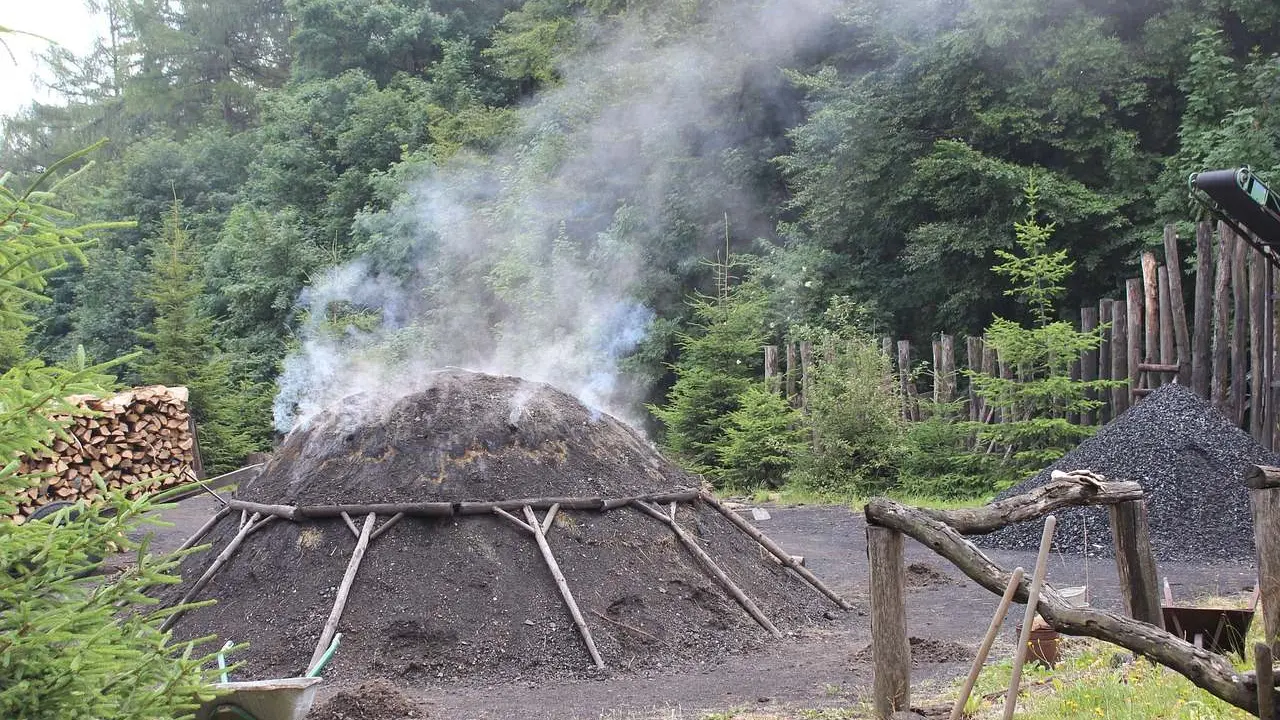
Penn State Extension defines biochar as thermally treated biomass that consists primarily of carbon. A second Penn State article, on opportunities and limitations, describes production by pyrolysis, which means heating organic biomass in a low-oxygen environment. Pyrolysis also produces other byproducts, such as bio-oil and syngas. Feedstocks named there include wood chips, crop residues and manure solids.
The same Penn State fact sheet says the process temperature can vary from 200 to over 1000°C and the treatment time from a fraction of a second to several hours. Much of the dry mass is lost on the way, with yields ranging from 90% down to 10%. Oxygen must be drastically limited, because otherwise the feedstock tends to burst into flames. Biochar typically contains 50 to 80 percent carbon, depending on the parent substrate and processing parameters. It can also arise as a byproduct of fast pyrolysis or gasification, where the fact sheet says it is a small portion of the original mass of the feedstock.
The fact sheet stresses that not all biochar is equivalent and that its properties can vary dramatically.
Feedstock and temperature set the product
The Penn State opportunities and limitations article explains that wood-based feedstocks generally produce biochars with higher carbon content and specific surface area, but lower nutrient and ash content than crop-residue or manure-derived biochars. Herbaceous and manure-based feedstocks tend to yield biochars with higher nutrient concentrations and higher ash content.
Temperature matters as well. According to the same article, higher pyrolysis temperatures (generally above 500 °C) consistently increase carbon content, pH, ash content and specific surface area, while biochars made at 500 °C or lower retain more oxygen-containing functional groups, giving greater cation exchange capacity but generally lower stability. The article says the lower hydrogen-to-carbon ratios of these higher-temperature biochars indicate greater aromaticity and stability, often corresponding to long-term persistence in soil with potential residence times ranging from decades to centuries, and it summarises temperature as a tradeoff between chemical reactivity and long-term stability. Another Penn State fact sheet gives an estimated life of at least 1000 years, with some studies estimating an average of 5000 years, so the published estimates differ in how long the carbon is expected to last.
Application rates in the extension literature
The Penn State fact sheet states that there are currently no publications with a recommended application rate of biochar for any of the Mid-Atlantic or surrounding states. It notes that a Utah Extension factsheet recommends a maximum application rate of 10 tons per acre, and that a supplemental nitrogen application may be required because some of the nitrogen bonds to the biochar.
The other Penn State article adds that excessive rates can reduce yield, typically by immobilizing nutrients and making them unavailable to plants, and that high rates have been shown to raise soil pH beyond optimal levels. It also notes that biochar applied to the surface in no-till systems should be paired with other management practices, such as manure applications, to keep dust and erosion to a minimum, and that biochar applied superficially rather than incorporated can lose nutrients through runoff.
What field results and reviews report on yield
Yield outcomes are mixed. According to Penn State Extension, biochar has shown a significant yield increase in some cases, while in others it has had no impact or even reduced yields. Low-nutrient biochars, such as those made from woody biomass, applied without fertilizer may have no impact on yield, and sandy or low-nutrient soils generally show more benefit, particularly when biochar is applied with fertilizer.
A meta-analysis cited in a Penn State fact sheet found lots of variation in reported crop yield increases, but an average increase of 10% is typical. A global-scale meta-analysis published in 2017 in Environmental Research Letters reached a more regional conclusion: biochar had, on average, no effect on crop yield in temperate latitudes, yet a 25% average increase in yield in the tropics. In the tropics the authors attribute the increase to liming and fertilization, and for temperate zones they suggest management focus on potential non-yield benefits.
One long-term dryland trial
A field experiment reported by Oregon State University Extension gives a concrete example, though it is a single site in a semiarid wheat system and should not be read as a general result. The experiment was established in 2013 on Walla Walla silt loam soil near Pendleton. Biochar made from forest waste was applied once at three rates in a winter wheat–spring pea rotation.
The researchers reported that biochar increased soil pH by up to 0.9 units, with the strongest and longest-lasting effects in plots that received higher rates, concentrated in the surface soil layer. Compared with non-amended control plots, soil organic carbon stocks increased by 95% to 207%, depending on the application rate. Carbon levels were somewhat lower in later measurements, but treated plots still showed lasting gains.
The same Oregon State report says early yield data showed that biochar paired with mineral nitrogen improved crop performance compared with nitrogen alone, though responses differed by crop: wheat showed modest gains at moderate rates, and spring peas showed a stronger response at the lowest rate tested. The highest rate gave no additional yield benefit and was associated with greater year-to-year variability in wheat. The report’s summary is that biochar may work best when matched to soil conditions, crop needs and fertilizer management rather than applied as a one-size-fits-all amendment.
Soil structure, carbon and nutrient effects
Penn State’s opportunities and limitations article says biochar can improve aggregate stability, raise pH, increase soil carbon storage and improve water retention, but that results can be quite variable depending on the type of biochar, the application rate and the soil characteristics. Low to moderate rates can improve soil aggregation and carbon storage, with varying effects across soil types and biochar types, and the improvement in aggregation is generally less effective in sandy or coarse-textured soils.
On runoff, the same article reports that higher rates are required for a significant impact on runoff volume and that results vary even with the same biochar at the same rate; the largest impact is often seen in compacted soils with initially low infiltration. Its summary of nutrient effects is that they are mixed, depending on soil, crop, timing and biochar type. The article adds that biochar can adsorb ammonium and nitrate and temporarily limit plant access to them.
The carbon stored in soil is a broader subject, and soil carbon sequestration covers how it is built and where its limits lie. Biochar is one soil-focused option among several on a farm; practices such as cover crops are covered separately.
Limits, trade-offs and testing
The Penn State fact sheet cites a 2011 study (Graber) in which a high specific surface area biochar (EUC-800) applied at high rates affected the efficacy of the herbicide sulfentrazone, while a low specific surface area biochar at the same rate did not. The fact sheet warns that using the wrong product or the wrong rate could have long-term effects on the agronomic practices that work. The second Penn State article notes that reduced bioavailability of pesticides may limit their efficacy and require higher application rates.
Contamination is also flagged. According to the same article, some biochars may contain potentially harmful substances such as polycyclic aromatic hydrocarbons, volatile organic compounds and heavy metals. It advises obtaining a biochar’s analytical test results before considering it for use on land, with tests done to the American Society of Agricultural and Biological Engineers standard S668. Manure-based biochars can contain higher salts and sometimes other unwanted pollutants, so any biochar used in food crops should be verified as tested and meeting safety standards.
The article also states that in some cases biochar improves soil health without any yield benefit, and that where the goal is carbon capture the available carbon incentives may not cover the cost of the biochar. It calls for site-specific evaluation before application. Rules on soil amendments and carbon programmes differ by place and change over time, so the current official requirements are worth confirming locally.
Handling and storage hazards
The Penn State article on safe handling says that, despite being a stable carbon material, biochar presents dust, fire and self-heating hazards if not properly managed. Its guidance, summarised here:
- Dust: biochar can generate airborne particulate matter during handling such as sieving, transfer or packaging, associated with respiratory risks through deep lung penetration or upper airway irritation. Exposure can significantly exceed recommended occupational limits if controls are not in place.
- Dust controls: lightly wetting biochar before handling, minimizing drop heights during transfer, and adequate ventilation or dust extraction in enclosed spaces.
- Protective equipment: N95 respirators, gloves, eye protection and full skin coverage are recommended to protect workers from inhalation and contact hazards.
- Fire and self-heating: spontaneous combustion is possible, particularly when biochar is freshly produced or very dry. Fresh biochar can rapidly absorb oxygen, generating an exothermic reaction that may lead to self-heating and ignition without an external heat source. The risk is heightened with residual volatile compounds or when fine particles accumulate in confined spaces, where dust explosion hazards may occur.
- Storage: a moisture level of 30 to 40% is typically appropriate for safe bulk handling because wetter material is less prone to ignition. Storage areas should be cool, dry and well ventilated, away from heat sources and oxidizing agents. Flexible bulk containers are preferred because they allow heat dissipation, and continuous monitoring of stored material temperature is advised to detect early signs of self-heating.
Frequently asked questions
Does biochar always raise crop yields?
No. Penn State Extension reports that biochar has raised yields in some cases and had no impact or reduced yields in others, and a global meta-analysis in Environmental Research Letters found no average effect in temperate latitudes.
Does biochar change soil pH?
Penn State says biochar generally has a liming effect that raises pH more slowly than lime but lasts longer, and also notes that high rates can push pH past optimal levels. The Oregon trial recorded an increase of up to 0.9 units at a single site.
Can biochar interfere with herbicides or pesticides?
It can. Penn State describes a study in which a high-surface-area biochar at high rates affected a herbicide’s efficacy, and a second Penn State article says reduced pesticide bioavailability may require higher application rates, so the choice of product and rate matters.
What should be known about a biochar before it goes on a field?
Penn State advises obtaining analytical test results, done to the ASABE standard S668, so that contaminants such as trace metals are not being added. It adds that any biochar used in food crops should be verified as tested and meeting safety standards.