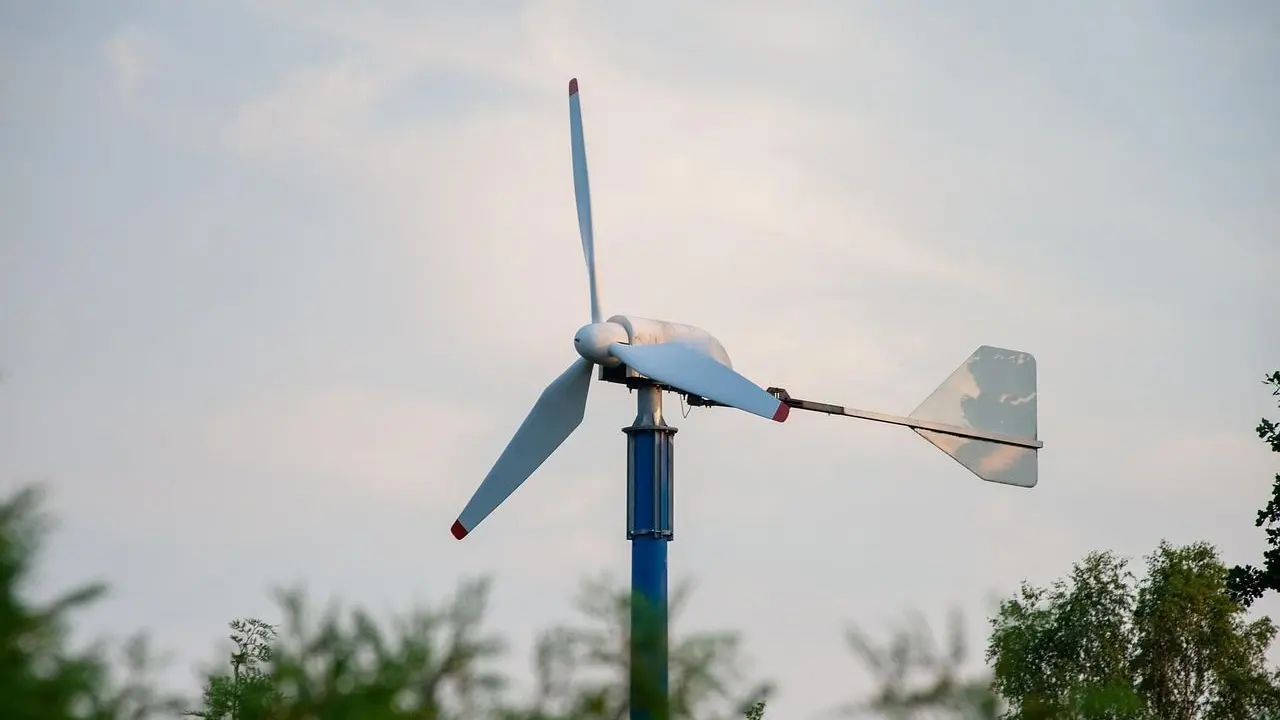
Small wind turbines are compact wind generators that supply electricity to a single farm, home or remote site. Whether one makes sense depends mostly on the local wind, the available land and the local rules.
This guide sits within the wider renewable energy coverage of algae biomass energy, which looks at fuels and power made from living matter.
How small wind turbines work
The US Department of Energy’s Small Wind Guidebook explains that wind is created by the unequal heating of the Earth’s surface by the sun, and that turbines convert the kinetic energy in wind into mechanical power that runs a generator to produce electricity.
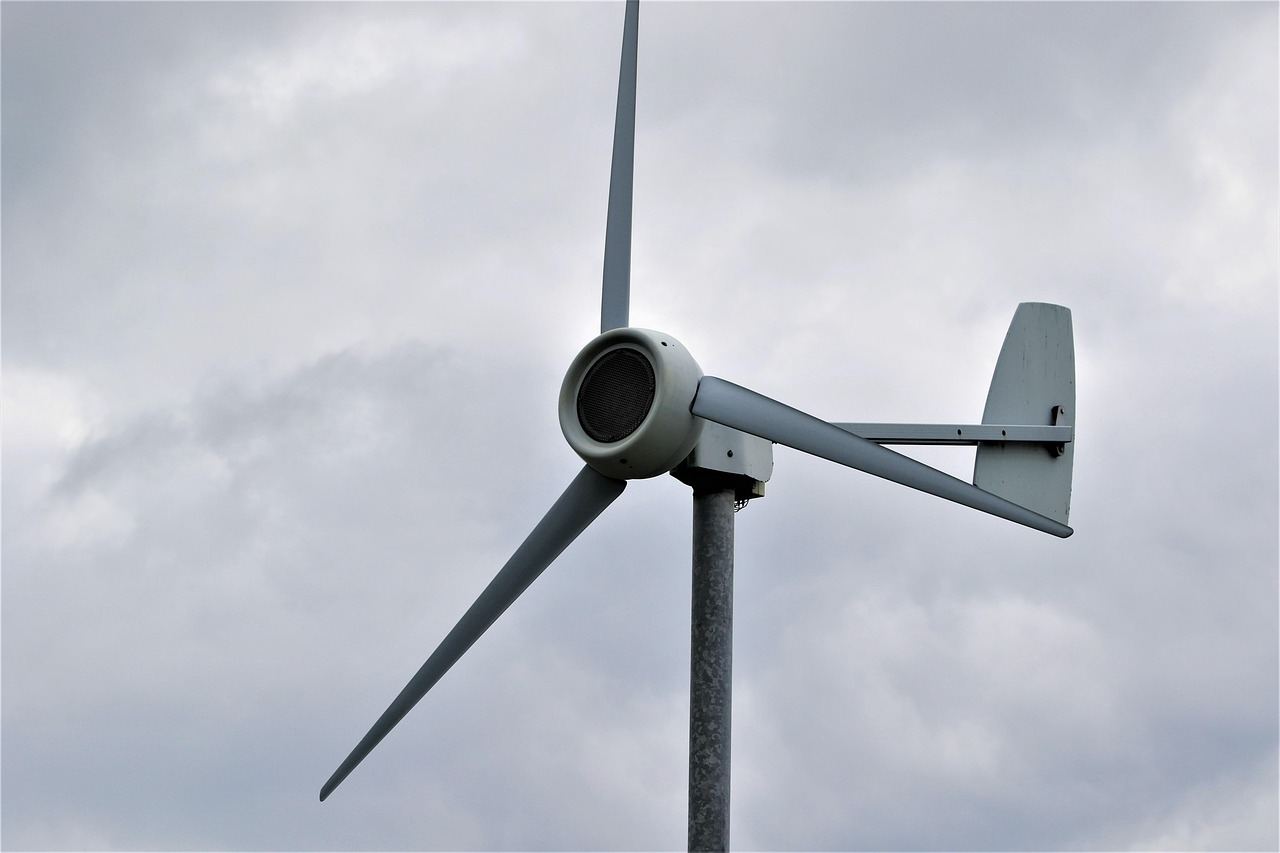
A home or farm system generally comprises a rotor, a generator or alternator mounted on a frame, a tail (usually), a tower, wiring, and “balance of system” components: controllers, inverters and batteries. The most commonly used design in today’s market is the horizontal-axis turbine. Vertical-axis designs also exist and come in two types, Savonius and Darrieus.
The same guidebook makes a point that matters for planning: power depends on the swept area of the rotor and on the cube of the wind speed, which it writes as Power = Cp 1/2 ρ A V³. Because of that relationship, even a small increase in wind speed results in a large increase in power.
Sizes and typical uses on rural properties
According to the Small Wind Guidebook, small turbines range in size from 20 watts to 100 kilowatts. The DOE distributed wind page gives the same spread in practical terms: installations can range from a less-than-1-kilowatt off-grid turbine powering telecommunications equipment to a 15-kilowatt turbine at a home or small farm.
The Small Wind Guidebook uses a typical home as a yardstick: a typical home uses an average of 877 kWh per month, and depending on the average wind speed in the area, a turbine rated in the range of 5 to 15 kW would be required to make a significant contribution to that demand. It adds that because energy efficiency is usually less expensive than energy production, making a house more efficient will probably be more cost effective and will reduce the size of the wind turbine needed.
The DOE distributed wind page says individuals, businesses and communities install distributed wind energy to offset retail power costs or secure long-term power cost certainty, support grid operations and local loads, enhance reliability with backup power, and electrify remote properties and infrastructure not connected to a centralized grid. For water pumping, the Small Wind Guidebook notes that in areas with a low wind resource, mechanical windmills can provide more efficient water pumping than wind-electric systems.
Is there enough wind at the site?
The Small Wind Guidebook says the highest average wind speeds in the United States are generally found along seacoasts, on ridgelines and on the Great Plains, and that the wind resource can vary significantly over an area of just a few miles because of local terrain influences on the wind flow.
State wind maps give a general indication of good or poor wind resources, but the guidebook says they do not provide a resolution high enough to identify local site features. Data from airport and weather stations may only provide a rough screening assessment, although the guidebook notes that average wind speeds may be 15% to 25% greater at a typical hub height of 80 ft (24 m) than those measured at airport anemometer heights. Gathering on-site, measured wind data is typically preferred.
For grid-connected systems, the same source lists living in an area with an average annual wind speed of at least 10 mph (4.5 m/s) among the conditions under which a system can be practical.
Towers, turbulence and placement
Because wind speeds increase with height, a turbine is mounted on a tower, and in general the higher the tower, the more power the system can produce, according to the Small Wind Guidebook. A general rule of thumb is to install the turbine with the bottom of the rotor blades at least 30 feet (9 meters) above any obstacle that is within 300 feet (90 meters) of the tower. Elsewhere the guidebook states the clearance as 30 feet above anything within a 500-foot horizontal radius, and it mentions experienced small wind site assessors, who can determine where a turbine should be located on a property.
Obstacles matter because of turbulence, which the guidebook says can reduce the annual energy output estimate from 15% to 25%. The guidebook also says the turbine needs to be sited upwind of buildings and trees, with enough room to raise and lower the tower and, for a guyed tower, room for the guy wires.
The guidebook also addresses rooftops. It states that all wind turbines vibrate and transmit the vibration to the structure on which they are mounted, and that this can lead to noise problems within the building. The rooftop wind resource is also in an area of increased turbulence, which can shorten the life of the turbine and reduce energy production. According to the guidebook, the added costs of mitigating these concerns, combined with lower power output, make rooftop-mounted turbines less cost-effective than small wind systems installed on a tower connected to the ground.
Zoning, permits and grid connection
The Small Wind Guidebook draws a distinction between the two: zoning refers to the general local regulations that allow and restrict various types of projects, whereas permitting refers to acquiring permits for a specific project within the scope of those zoning rules. It adds that practices vary dramatically across the country, and that most zoning ordinances have a height limit of 35 feet. It also lists at least 1 acre of land among the conditions under which a small wind system can be practical.
Common concerns include sound level, visual impact, wildlife impact, TV/radio interference, ice shedding and broken equipment. On sound, the guidebook gives an example: a typical 2-kilowatt wind turbine operates at a noise level of approximately 55 dB 50 feet away from the hub of the turbine. A project that falls outside defined limits must usually undergo a special review process to obtain a variance.
The DOE’s WINDExchange permitting and zoning page points to a database of wind energy ordinances compiled from around the country. The guidebook suggests contacting the local building inspector, board of supervisors or planning board to learn what a given area requires, and electrical codes from the local city, county or state government probably apply as well. Rules and incentive programmes change, so confirm the current local rules and any programme terms with those offices and the programme administrators.
For a grid connection, the guidebook explains that interconnection typically requires utility permission, usually in the form of an interconnection agreement. The utility’s principal concern is that the turbine automatically stops delivering any electricity to its power lines during a power outage. Net metering varies by state and by utility company. The guidebook notes that most of North America sees more wind in the winter than in the summer, so where net metering rules allow annual net excess generation (NEG) credit, people using wind to displace a large summer load such as air conditioning or irrigation water pumping can produce NEG in the winter and receive credits in the summer.
Without a grid connection, the guidebook notes that stand-alone systems require batteries to store excess power for use when the wind is calm. In grid-connected systems the only additional equipment required is an inverter, and batteries are usually not required.
Costs, upkeep and lifespan
The Small Wind Guidebook reports that the capacity-weighted average cost of small wind projects installed in 2021 was $5,120/kilowatt, based on 16 projects in three states for a combined rated capacity of 396 kW. It also states that installation costs vary greatly depending on local zoning, permitting and utility interconnection costs.
The length of the payback period depends on the system chosen, the wind resource on the site, electricity costs in the area and how the system is used. The cost figure above is a published sample from the guidebook, not a quote for any property.
On upkeep, the guidebook says many turbines require periodic lubrication, oil changes and replacement of wear surfaces such as brake pads. After 10 years the blades or bearings may need to be replaced, but with proper installation and maintenance the machine should last 20 years or longer. It also points readers to the Small Wind Certification Council, which provides independent, accredited certification of small wind turbines and consumer information.
Wind among other on-site energy options
Wind is one of several ways to produce energy on a farm or rural property. For heat rather than electricity, the guide to biomass heating covers wood pellet and other biomass systems. The explainer on how solar panels work covers the other common source of on-site electricity.
Frequently asked questions
What counts as a small wind turbine?
The Small Wind Guidebook says small turbines range in size from 20 watts to 100 kilowatts, with the smaller units used for jobs such as charging batteries.
Can a small wind turbine be mounted on a roof?
The guidebook notes there have been rooftop installations, but all wind turbines vibrate and transmit that vibration to the structure, which can cause noise problems inside the building; rooftop turbulence can also shorten turbine life and reduce energy production, and it says rooftop systems are less cost-effective than tower-mounted ones.
Do small wind turbines need a permit?
Requirements vary by location. The guidebook says practices vary dramatically across the country and recommends contacting the local building inspector, board of supervisors or planning board to find out what applies.
Can a small wind turbine work without the grid?
Yes. The guidebook explains that stand-alone systems, which are not connected to the utility grid, require batteries to store excess power for use when the wind is calm, while grid-connected systems usually do not need batteries.