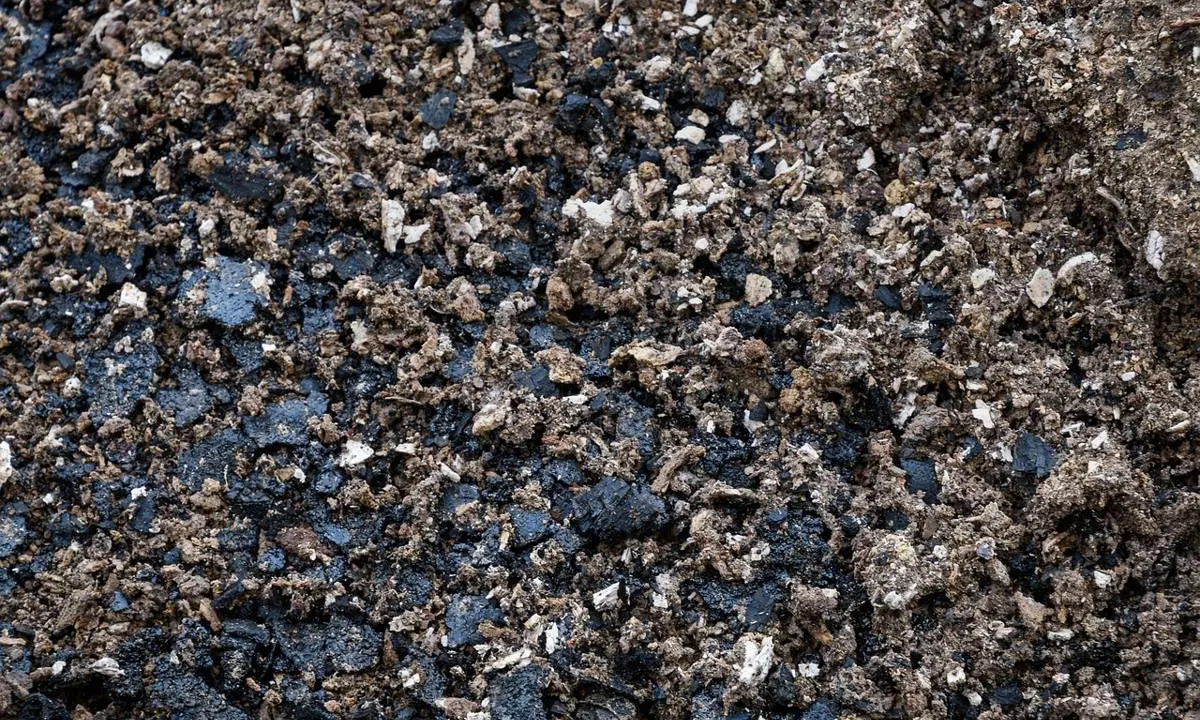
Biochar for gardens means mixing a carbon-rich, charcoal-like material into garden soil, mainly to change how the soil holds water, nutrients and acidity. Extension sources describe results that depend heavily on the soil and on the biochar itself.
This guide sits within organic gardening for beginners, and it looks at what biochar is, what it does in a bed, where it can cause problems and how to handle it safely.
Biochar compared with charcoal
Penn State Extension defines biochar as thermally treated biomass that consists primarily of carbon. The same fact sheet points out that not all biochar is equivalent and that its properties can vary dramatically. Charcoal from wood is, in its words, one form of biochar, but only one of the many possible types.
The Washington State University gardener’s primer describes biochar as a fine-grained charcoal left behind after pyrolysis of crop residues, livestock manures and other organic material. It explains that a finished biochar is specific to the material that was burned to produce it, so one made from straw differs from one made from coconut husks, yard waste or wooden pallets. The range of temperatures and times used in making it also produces biochars that are chemically and physically different from one another.
That variation is the reason the evidence for biochar in gardens is hard to summarise in a single sentence. A result recorded with one feedstock and one production temperature does not automatically carry over to another product, a point the Penn State and Washington State fact sheets both make.
Effects of biochar on garden soil
The Washington State fact sheet links several of biochar’s effects to its porous structure and its charged surface. It says the porous material improves aeration of poorly drained or compacted soils while increasing the water-holding capacity of fast-draining, sandy soils. It also says the porous nature of biochar provides a physical home for bacteria and fungi, including beneficial mycorrhizal species.
On nutrients, the same primer explains that biochar’s negatively charged surface binds positively charged chemicals, including hydrogen ions and many plant nutrients. Binding the hydrogen ions raises the pH of the soil, making it increasingly alkaline, while nutrients that might otherwise leach out of the soil are held on the biochar instead.
A second Penn State publication, on soil health and water quality, lists the improvements that biochar can bring: better soil aggregate stability, a higher pH, more buffering capacity, more cation exchange capacity, improved water retention and increased microbial activity. It then adds an important qualification, that results can be quite variable depending on the type of biochar, the application rate and the soil characteristics.
Soil acidity and pH
Biochar is usually alkaline. Penn State’s properties and potential fact sheet states that biochar has a high pH, typically ranging between 10–11 pH, with variation depending on the feedstock, and that it will increase the pH of the soils it is applied to. The other Penn State publication describes a liming effect that raises soil pH more slowly than lime but lasts longer, which it calls particularly beneficial in amending acidic soils.
A field trial reported by Oregon State University Extension gives a concrete example. In a long-term dryland wheat experiment using biochar made from forest waste, biochar increased soil pH by up to 0.9 units, with the strongest and longest-lasting effects in plots that received higher rates. That was a farm field with a winter wheat and pea rotation rather than a garden bed, so it shows what is possible rather than what any garden will see. Penn State adds that the length of time biochar will buffer the soils is unknown.
Soils that respond best
The Washington State fact sheet includes a table summarising benefits, drawbacks and the conditions where each effect is most useful. Its entry for water-holding capacity lists excessively drained, sandy soils as the best use and notes that biochar can cause waterlogging in heavy clay soils. Compacted soils are listed as the best use for reduced bulk density, and heavy or compacted soils for improved aeration.
The Penn State soil health publication agrees that sandy or low-nutrient soils generally show more benefit from biochar, particularly when it is applied with fertilizer. It also says that biochar application is generally less effective in improving aggregation in sandy or coarse-textured soils. In other words, the benefit being sought, whether better water retention or better crumb structure, changes which soil is the better candidate.
Soil organic matter matters too. According to the Washington State table, biochar is less effective in soils rich in organic matter, and excessive biochar in such soils can reduce growth, while organic-matter-poor and dry soils are listed as the best use. The same table notes that the added alkalinity may injure acid-loving plants and earthworms and suits soils used for alkaline-tolerant species such as turf grasses.
On how much evidence exists for home gardens specifically, the Washington State fact sheet states that there are only a handful of studies on biochar with direct relevance to home gardens and landscapes.
Drawbacks and cautions
The same Washington State fact sheet is direct about the cautions. Application of too much biochar can injure plants, possibly by increasing soil alkalinity past the plant’s tolerance level. Applying biochar to soils rich in organic matter can temporarily reduce nitrogen levels because increased microbial activity competes with plants for this nutrient, and the fact sheet suggests monitoring plants during the first few months for signs of nitrogen deficiency, noting that overall leaf yellowing is an indicator of low nitrogen.
It also warns that adding too much biochar can injure beneficial soil organisms such as earthworms, and can reduce the effectiveness of soil-applied pesticides. Penn State’s fact sheet makes a related point for herbicides and pesticides: a biochar with a high specific surface area applied at high rates can bind them up, making them ineffective. Gardeners who use soil-applied treatments as part of organic pest control should be aware that extension sources describe this interaction.
Nutrient effects are not uniform either. The Penn State publication says biochar’s impacts on nutrient management are mixed, depending on soil, crop, timing and biochar type, and that excessive rates can reduce yield, typically by immobilizing nutrients and making them unavailable to plants. The Oregon State trial found a similar pattern at field scale, where the highest rate did not provide additional yield benefit and was associated with greater year-to-year variability in wheat. Oregon State’s conclusion is that biochar may work best when matched to soil conditions, crop needs and fertilizer management rather than applied as a one-size-fits-all amendment.
Choosing, testing and handling biochar
For gardeners who want to try it, the Washington State primer advises using only a commercially produced biochar with well-defined characteristics, and being careful about application because improper application can create problems in a garden.
Penn State goes further on quality. Its soil health publication says it is important to obtain a biochar’s analytical test results before considering it for use on land, to ensure that contaminants such as trace metals are not being added to the soil. It specifies that tests should follow the American Society of Agricultural and Biological Engineers standard S668 and that these reports often list a safe threshold for each contaminant.
Handling matters as well. The same Penn State publication says that despite being a stable carbon material, biochar presents dust, fire and self-heating hazards if not properly managed. It notes that biochar can generate airborne particulate matter during handling activities such as sieving, transfer or packaging, and that such particles are associated with respiratory risks. To reduce them, it recommends dust suppression such as lightly wetting biochar before handling, minimizing drop heights during transfer, and adequate ventilation or dust extraction in enclosed environments. Personal protective equipment, including N95 respirators, gloves, eye protection and full skin coverage, is also recommended to protect workers from inhalation and contact hazards.
On fire, the Penn State publication says biochar presents a unique fire and storage hazard due to its potential for spontaneous combustion, particularly when freshly produced or very dry. Fresh biochar can rapidly absorb oxygen, generating an exothermic reaction that may lead to self-heating and ignition without an external heat source. Penn State adds that this risk is heightened when biochar contains residual volatile compounds or when fine particles accumulate in confined spaces, where dust explosion hazards may occur.
For storage, the same Penn State publication recommends maintaining appropriate moisture levels, noting that typically 30 to 40% moisture is appropriate for safe bulk handling because wetter material is less prone to ignition. It says storage areas should be cool, dry and well-ventilated, and that biochar should be kept away from heat sources and oxidizing agents. It also states that flexible bulk containers are preferred because they allow heat dissipation, and that continuous monitoring of stored material temperature is advised to detect early signs of self-heating.
Compost is a different soil amendment, covered in the guide on how to compost at home.
Biochar persistence in soil
Persistence is one of biochar’s defining traits, but sources say it varies with how the biochar is made. The Washington State fact sheet says biochar is so slow to decompose that scientists widely consider it a long-term repository for stored carbon, and that it remains virtually intact for centuries.
Penn State is more specific about the range. Its soil health publication says biochar is capable of persisting in soils for decades to centuries, and that in general higher production temperatures favor persistence and sorptive capacity, whereas lower temperatures favor nutrient exchange and short-term reactivity. Feedstock composition, it adds, strongly influences biochar characteristics.
Field evidence supports a long-lasting effect in at least one setting. The Oregon State study found that a single biochar application continued to improve soil conditions for more than 10 years, although carbon levels were somewhat lower in later measurements.
Frequently asked questions
Is biochar the same as the charcoal used for cooking?
Not exactly. Penn State describes wood charcoal as one form of biochar, among many possible types that differ by feedstock and by how severely the biomass was heated.
Does biochar make soil more acidic or more alkaline?
More alkaline. Extension sources describe biochar as typically alkaline, with a liming effect that is slower than lime but lasts longer, and Washington State notes it may injure acid-loving plants.
Can adding biochar affect nitrogen in the soil?
Yes. Washington State says that applying biochar to soils rich in organic matter can temporarily reduce nitrogen levels, and that leaf yellowing is a sign of low nitrogen to watch for in the first few months.
Does biochar affect earthworms or pesticides?
Washington State states that earthworm populations often decline in biochar-amended soils and that too much biochar can reduce the effectiveness of soil-applied pesticides.
Is biochar safe to handle?
Penn State cautions that biochar presents dust, fire and self-heating hazards if not properly managed, and recommends dust suppression, ventilation and protective equipment including N95 respirators, gloves, eye protection and full skin coverage. It also warns that fresh or very dry biochar can self-heat and ignite without an external heat source, and that storage areas should be cool, dry and well-ventilated, with biochar kept away from heat sources and oxidizing agents.